Tea towel sizes and hems: making up panama and drill
A good tea towel depends on the cloth, but also on the size, the hem and the loop. Here is how panama and drill are cut and made up.
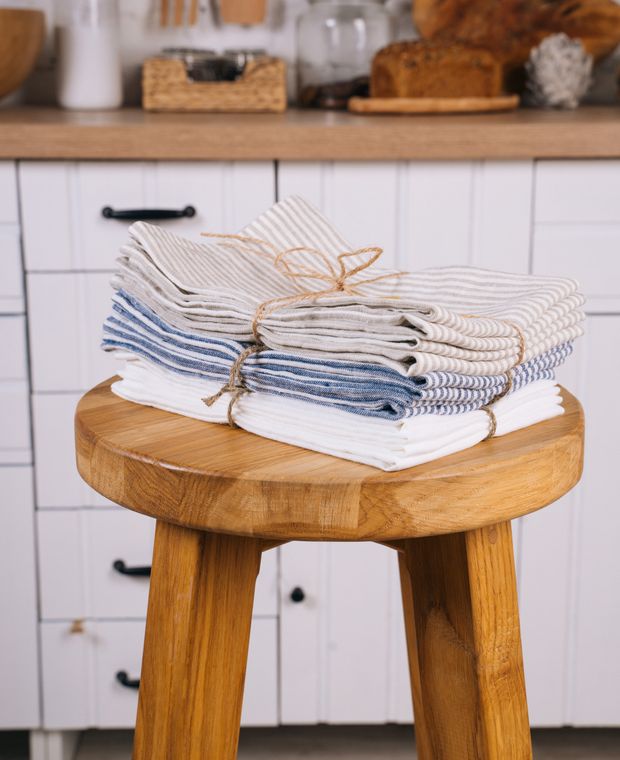
A tea towel is a simple product, but small making-up decisions decide whether it stays flat and square after a hundred washes or twists at the corners after five. Size, hem construction, stitching and the hanging loop all interact with the fabric. Panama and drill, the two classic tea towel cloths, behave differently in making up, and it is worth planning for each.
Common sizes
There is no single standard size. Most tea towels fall between about 45 x 65 cm and 50 x 80 cm finished, with 50 x 70 cm a widely used size. Smaller sizes suit promotional and gift sets; larger ones are preferred for drying glassware and in professional kitchens.
| Finished size | Cut size, 2 cm double hem all round | Typical use |
|---|---|---|
| 45 x 65 cm | 49 x 69 cm | Promotional, gift sets |
| 50 x 70 cm | 54 x 74 cm | Everyday retail |
| 50 x 80 cm | 54 x 84 cm | Glass drying, professional use |
Add a shrinkage allowance to the cut size if the fabric is not fully preshrunk or the towels will be washed after making up. Cotton can shrink by several per cent in length and width; the right figure comes from a domestic wash test such as an ISO 6330 procedure on the actual quality.
Hems
- Double-folded hem. The edge is turned twice, for example 1 cm then 1 cm, and stitched, so no raw edge is exposed. This is the standard for tea towels, because it survives hot washing and tumble drying.
- Selvedge sides. Where the towel width runs along the warp, the selvedges can form the side edges, leaving only the two ends to hem. It saves fabric and sewing, but only if the selvedge is flat and even in shade.
- Overlocked edge. Quick and cheap, but less durable and less finished in appearance. It suits disposable or promotional pieces more than a product meant to last.
At the corners, fold the side hems before the end hems, or mitre them, to keep bulk down and the corners square.
Panama: open weave, careful edges
Panama is a basket weave, with pairs of yarns working together. It is absorbent and lies flat, but its open structure frays more readily than a dense weave, so a fully enclosed double hem is important. Our panama is woven at 230 gsm, the lighter quality for everyday and promotional towels, and at 309 gsm for heavy, premium towels. The heavier cloth builds more bulk at a double hem, so a slightly narrower fold, or a stronger needle, helps at the corners.
Drill: dense and firm
Drill is a cotton fabric in a twill weave, denser and smoother than panama, with more body. Our Cotton Drill is 255 gsm. It frays less and holds a crisp fold, so hems press flat and look sharp. The diagonal twill line has a face and a back, so cut all pieces with the face on the same side, and fold hems to the back. Because drill is firm, a tea towel in drill feels more substantial, and it also carries a printed logo or border well.
Stitching and loops
- Stitch length. Around 3-4 stitches per centimetre gives a hem that is secure without puckering.
- Thread. A strong cotton or polyester core-spun thread, in a colour matched to the ground or chosen as a deliberate contrast.
- Hanging loop. A tape or folded fabric loop of about 10-12 cm, stitched into the hem at a corner or at the centre of one end, and caught by a second line of stitching so it does not pull out.
- Label. A care label sewn into the hem, positioned so it does not show when the towel hangs.
Before bulk
Make up a few towels from the production cloth, wash them several times as the customer would, and check size, squareness and hems. It is the quickest way to catch a shrinkage or corner problem. Our tea towel fabrics in panama and drill are supplied piece-dyed or printed; for placement designs, see reactive digital printing. Ask us for a sample of the quality you have in mind.