Choosing a trouser fabric weight for the season and cut
Weight decides whether a trouser feels airy or substantial, and whether a cut hangs or holds. Match the gsm to the climate first, then to the cut.
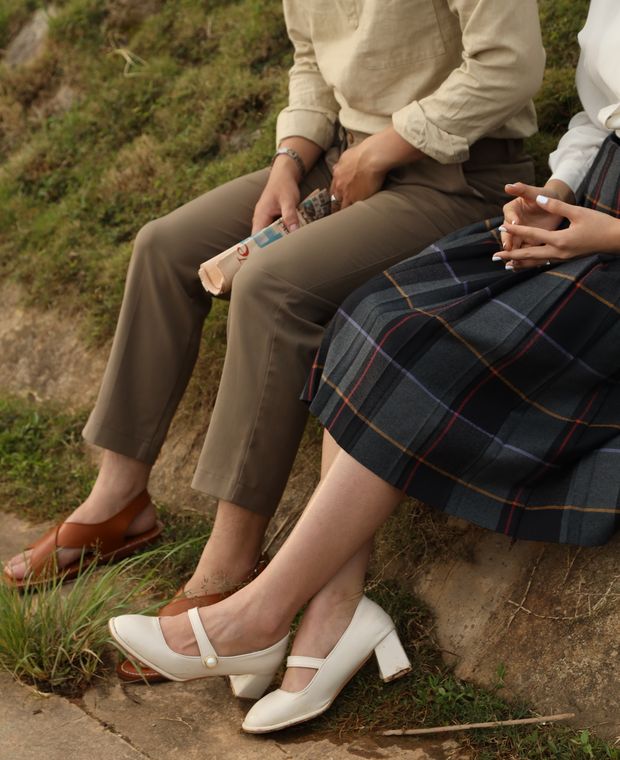
Two trousers in the same style can feel like different garments if the cloth weight changes by 60 or 80 gsm. Weight affects warmth, drape, opacity, durability and how the trouser holds a crease. Choosing it well starts with two questions: when will it be worn, and how is it cut?
The weight bands
Trouser fabrics usually fall between about 170 and 300 gsm. The bands below are practical guides, not fixed rules, because weave and fibre also change how a weight feels.
| Weight | Feel | Best for |
|---|---|---|
| 170-200 gsm (5-6 oz/yd²) | Light, airy, soft drape | Hot weather, relaxed and wide-leg trousers |
| 200-250 gsm (6-7.5 oz/yd²) | Balanced, all-round | Chinos and smart casual trousers worn most of the year |
| 250-300 gsm (7.5-9 oz/yd²) | Substantial, warm, structured | Cold weather, workwear-inspired and tailored trousers |
Matching weight to climate
For hot climates and summer ranges, lighter cloths breathe better and feel less clinging. Blends with linen or lyocell help further because they feel cool and absorb moisture. The trade-off is opacity: very light pale colours can show through, so check a light-coloured sample against the skin and against pocket bags and linings.
For cold weather, heavier cloths trap more air and block wind. A dense cotton-elastane or a wool blend at the upper end of the range gives a warmer trouser that still moves easily.
Many ranges settle on a mid weight that works across most of the year, then add a lighter and a heavier option for the hottest and coldest months. That keeps the core trouser consistent while the cloth follows the season.
Matching weight to cut
- Slim and tapered: the cloth works hard at the knee and seat. A mid weight, around 220-260 gsm, with a few percent elastane, gives comfort and recovery without looking thin.
- Relaxed and straight: almost any weight works. Choose by season.
- Wide-leg and pleated: the trouser needs to swing, so a lighter cloth with fluid drape, such as a cotton-lyocell or modal-lyocell, often hangs better than a stiff mid-weight.
- Tailored: a crease line holds best in a firmer, heavier cloth, or in wool.
- Utility and cargo: heavier weights resist abrasion and carry the weight of pockets without dragging.
Other things weight affects
Opacity: pale colours in light cloth need checking against the skin, as noted above. Durability: at the same construction, heavier cloth usually resists abrasion and pilling better. Seam slippage: light, smooth cloths are more prone to seams pulling open under stress, so ask for seam strength on light qualities. Cost: fabric is often priced per metre, and a heavier cloth uses more fibre per metre, so weight feeds directly into cost per garment.
Our trouser range by weight
Our trouser fabric collection covers 170 to 290 gsm. At the light end are the linen blend KT-01 (170-175 gsm), the cotton-lyocell PL-01 and PL-02 (180-195 gsm) and the cotton-polyamide PP-01 (186 gsm). The middle holds most of the cotton-elastane qualities (219-251 gsm), the modal-lyocell ML-01 and PL-03. The heavy end includes PE-08 and PE-09 (276-280 gsm), PL-04 (270 gsm), PL-05 (290 gsm) and the wool blend YN-01 (290 gsm).
A short checklist
- When and where will the trouser be worn?
- What is the cut, and does it need to hold a crease or swing?
- Does it need stretch, and how much?
- How pale is the colour, and is opacity a risk?
Send us those answers and we will suggest two or three qualities to sample side by side.